
Showing posts with label Vegan. Show all posts

Sunday, 3 March 2013

More on Protein


Just in case you didn't feel satisfied by the information in my last post, I thought I would provide a more detailed account on vegetarian/vegan friendly protein sources.

The soybean is an important protein in any meat-free diet.  Soybeans contain all essential amino acids – there are 10 – and provide a respective amount of protein to the human body. 

Soybeans can be consumed in their original form, and actually make a great addition to your favourite trail-mix, but they can also be found in a wide variety of soy-based products.  Soy milk, tofu, veggie burgers and dogs are only a few of the products available to vegetarians and vegans.  The soybeans are miraculous in that the many different forms take on a variety of flavours guaranteed to satisfy a range of tastes. 

Aside from soybeans, vegetarian/vegan protein comes from sources such as:
Legumes: garbanzo beans, kidney beans, lentils, lima beans, navy beans

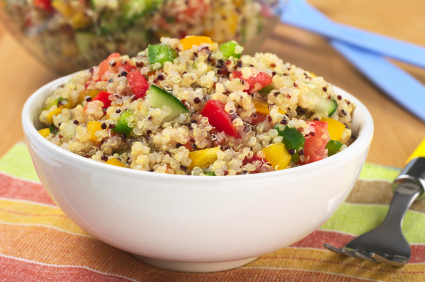
Grain: barley, brown rice, buckwheat, oatmeal, quinoa, rye, wild rice

Vegetables: artichokes, beets, broccoli, cabbage, cauliflower, eggplant, green peas, kale, lettuce, mushrooms, onions, potatoes, spinach, watercress, zucchini … to name a few

Fruit: apples, bananas, melons, grapefruit, peaches, pears, pineapple

Nuts and Seeds: almonds, cashews, hemp seeds, peanuts, pumpkin seeds, sesame seeds, sunflower seeds, walnuts

And the list goes on.  So, as you can see, there are a wide range of proteins available to those who chose not to eat meat.  These options offer a variety of textures and tastes of which you’ll surely never be bored. 

Oh, and one last thing, to further support my previous claim that people tend to think we need more protein than is necessary, The Happy Cow says that “we need only 2.5 – 10% of our calories from protein, and ALL vegetables offer us more than that.”   

Friday, 15 February 2013

Vegetarian vs. Vegan


This message goes out to those of you who cannot seem to understand that being a vegetarian and being a vegan is not the same thing.  Vegetarianism and veganism are similar – yes, this is true – however, there are many distinct differences between the two.

As discussed last week, vegetarians abstain from eating animal flesh, aka meat.  "The Vegetarian Handbook" states that vegetarians survive mainly on plant foods such as fruits, vegetables, grains, etc.; however, some also consume animal by-products such as eggs and milk.

Vegans, on the other hand, abstain not only from all animal foods and by-products, but also from using any products derived from animals, as defined by "The Vegetarian Handbook."  Essentially, a vegan is an extremely strict and emphasized vegetarian. 

Many vegan diets are comprised of wholesome, energy-filled foods.  These diets are designed with a focus on unaltered, unprocessed foods such as raw fruits and vegetables, buts, seeds and grains.  There is little to no consumption of anything processed; therefore alcohol, coffee, tea, soda and even tobacco are considered taboo. 

Vegetarian and vegan diets are both concerned for the well-being of animals; however, their commitment and the degree to which they take action vary.  So, to all of you who think vegetarians and vegans are all the same, hopefully now you will see they are not.  

Source: Null, Gary. The Vegetarian Handbook: eating right for total health. Revised Edition. New York: St. Martin's Griffin, 1996. Print.

Friday, 8 February 2013

Defining Your Vegetarianism


It seems to me that a lot of people think there is one standard definition for a vegetarian and that any variation is not acceptable.  These people are sadly misled because there are actually several different types of vegetarianism.

Some vegetarians are stricter than others and therefore they follow a more rigid diet.  The most popular varieties of vegetarianism are ovo-, lacto-, ovo-lacto, semi- and vegan. 
  • Ovo-vegetarian: includes eggs but not dairy
  • Lacto-vegetarian: includes dairy but not eggs
  • Ovo-lacto vegetarian: includes both eggs and dairy 
  • Semi-vegetarian: includes fish and/or free-range poultry

Every one of these diets is similar, except for semi-vegetarian, in that they exclude all forms of meat.  Semi-vegetarians consume fish and/or poultry because they define meat only as “mammalian flesh”, as defined by Wikipedia.

Vegans are a completely different breed of vegetarian, if you ask me, but I will discuss that at a later date.  

As you can see, not all vegetarians are alike.  We all have our reasons for eating, or not eating, what we do, and there is no right or wrong way to be a vegetarian.  Vegetarianism is a personal lifestyle choice (key word being ‘personal’) and everyone has the right to define the parameters of their life.